I am twenty-something mama (1 human child, and 2 fur children) and wife. I am also an educator for at-risk young adults, focusing on ELA and Reading Intervention.
From the Washington Post article, this quote stuck out to me the most: “Bush seems to have calculated -- cynically but correctly -- that prolonging the credit-fueled consumer binge could help keep complaints about his performance as commander in chief from becoming more than a nuisance.” I became very mad upon reading this. When Bush told us to “go to Disneyland,” I was only a sophomore in high school, and was probably comforted by this statement. Now knowing what it has caused our nation with the present recession, I am very upset with what our former president told us. As a teenager, the shopping mall was where I went with my friends to socialize, and with my mom to kill time (and always bought random things that I “just had to have” and we spent money without even thinking). Even through my junior year in college, I spent a lot of time at the Mall of America because there wasn’t much to do on a Sunday afternoon (especially when I didn’t want to be doing homework). My fiancé and I live right next to the Light Rail station, and would just pop on the train and head down to the mall whenever we felt like it. That was when we didn’t have to worry about bills or future student loan payments, ect. Even though we didn’t go there with anything in particular to buy, but sure enough, we’d be riding the train back home with multiple bags in our hands.
After reading about the history of the shopping center and mall, it got me wondering about when was it within that history that marked the time when going to the mall became more than just a trip to get necessities for the home? When did it become a social phenomenon? As a kid growing up, I had always been somewhat aware of the fact that Southdale Mall in Edina was the first fully enclosed shopping center in the states, but to think about what an impact it had on the rest of the nation is incredible! From 1956 to 1968, shopping centers became more than just a place where you could go buy clothing for the family, or pick up some new towels at the department store. It became a place where one could go to admire the architecture and the wonderful décor of the interiors.
This is all I can post at the moment, as my computer/internet is being wonky. I'll get the rest posted before the end of the week!
Reading these articles got me thinking about my own relationship with video games, and being in a household with five women and only one man all living under the same roof (my poor dad- even the pets were all female!), and how we got our first Sega Genesis system when I was about 8 or nine years old. The video games we had in the house that I can distinctly remember playing included: “The Little Mermaid,” “Echo” (about a dolphin), “Sonic” (probably the most violent of the games that were given to us), “Bugsy,” and one other game where you were a newspaper boy and you had to go around delivering papers to clients in a certain amount of time. When my male cousin, Andy (who is only 6 days older than I am) would come over, we had to start hiding the Sega or else he would spend the whole time playing our “lame” games (as he would call them). If he got his hands on the controllers, he wouldn’t put it down until it was a.) Time for him to leave, or b.) He had beaten the game completely (something my sisters and I could never do, and to this day still haven’t). As the years passed, my family eventually became the owners of a PlayStation, Play Station II, PC computer, and various handheld devices after relentless begging on my sisters’ and my part. My parents never limited how much time we could play them based on the fact that we would get bored if we played for more than an hour at a time. Our game collection gained a few more violent games (ranging from a couple of World War II games, to Cabella’s Deer Hunting), but the game I see most often in the disc drive is The Sims. I moved from home for freshman year of college and found myself constantly surrounded by people who were video game fanatics! My boyfriend, Luke (now fiancé) lived in a room with three other guys, and if I walked into their dorm room at any given time, I would more than likely find at least 3 of them playing various video games all at the same time. I spent a lot of my time in that room, and learned more about video games than I ever thought I would. Who knew that watching the plot progress in Halo, Call of Duty or Grand Theft Auto could be so interesting? Or how detailed the character development is in BioShock or Gears of War? While I never actually actively partook in the games (except for a few lame attempts at Halo where I ran around in circles and get stuck against a wall), I found myself asking Luke to keep playing just so I could see what happened next. Now that I live with Luke, I am still surrounded by all sorts of gaming consoles including: an Xbox360, Nintendo Game Cube, N64, multiple computers, and a Nintendo DS.
After my two different living situations, I’ve had the chance to see how members of opposite genders approach video games. Not only do the majority of males and females seem to have different views and priorities concerning video games, the actual gender roles that are portrayed within these games. In Game+Girl=Advance, the author wrote early on that “As a woman who plays video games, I've had to think about gender in videogames, because it's so obvious that I'm playing in a boys' world.” When you look at women in video games (i.e., Lara Croft, etc.), they are the ideal women with tiny waists, and huge breasts. They can kick ass while looking gorgeous at the same time. This got me thinking about a good friend that I have who is in school to become an animator, and out of the sketches and final projects that I have seen of hers; her characters mimic the ideals of society. The men are tall with great hair and chiseled jaws, while the women are how I described them before. While her work is beautiful, and she has a great grasp on the art of animating, these standards are not going to go away. After reading the 4 aspects of “Genderspace,” I can definitely see why characters are made the way they are and the thought that has to go into them. The creators have to remember that “some people either take great pains to distance themselves from the avatar, or conversely, create avatars with which they identify very closely,” and need to take this into account to be successful.
GAMNG + EDUCATION
There are many people (parents, educators, ect.) who believe that video games are doing more harm than good when it comes to adolescents’ education. While to some it may seem like a waste of time, to others, it is a precious tool that can be used in the classroom to help reach out to students who don’t fully understand what is going on in class. Since I am on my way to become a high school English teacher, I want to try to use video games to enhance my lessons when necessary. Video games can be used in a variety of ways across a school campus, and in the English class, it can prove to be a valuable tool to get students to understand plot development, and different aspects of literature. Take for instance, if you were teaching a regular Language Arts class and you are trying to explain the concept of plot, climax, and character development to a group of young students who just aren’t grasping these important concepts. Many video games have cut scenes that they go to after the player has made it through a level. These cut scenes add to the story and let the player know what is going to happen next. As the player gets further and further into the game, they become more immersed in the plot of the game and often times become emotionally connected to the characters. This goes along the same lines as reading a novel. You get through a chapter and want to know what is going to happen next. You can sense the building climax through a novel just as you can through Halo or Bio Shock. While I wouldn’t want to have video games take over the classroom, I am very open to using pop culture and media with my students and I realize that video games can be used to enhance one’s classroom, and the power it can have when used correctly.
Parting quote (taken from Confessions of an Aca/Fan): “Our approach respects all that is inventive and exploratory in play while challenging students to grow intellectually. If we succeed in these goals, we hope to offer a model for what a good learning game should be, one that resolves the contradictory demands schools place on this emerging technology.”
As I was sitting here at my computer, I was trying to think about when I first remember becoming a fan of something. Back in the mid 1990s, I was talking with my past babysitter named Crystal. Crystal would bring over CDs every time she would come over to baby sit, and my three younger sisters and I thought that it was the most awesome thing ever (we only owned cassettes). One evening, Crystal brought over the Hanson CD, and she told me that since she had a crush on Taylor Hanson, I should have a crush on Zac Hanson (the youngest of the trio who was only a year older than I am). After a few minutes, I agreed and voila! I had my first celebrity crush and from that point on, I was officially Hanson’s biggest fan. At every gas station, I kept my eyes peeled for the latest issue of Teen Bop or Tiger Beat, which often featured the band on their covers and included inserts of Hanson posters. Although my mother warned me not to tape the posters to my walls, I just had to prove to my friends what a hardcore fan I really was. I can’t even come close to estimating how many hours I spend listening to their original tape and just HAD to have the new Hanson Christmas cassette as well. From then on, every time I would see Crystal in the neighborhood, we would spend a few minutes talking about how much we LOVED Hanson. Many of my friends didn’t understand why I liked this group of young guys so much, and often poked fun at me for it, but I didn’t care. If they didn’t want to share my interest with me, I had other people who I could dump my feeling and emotions about the band on. While I slowly lost interest in Hanson and eventually took down the magazine posters, this was my introduction to perpetual fandom that includes many areas of fandom.
Now, there is no way I can discuss what I am a fan of without including the incredible Harry Potter series. My grandmother introduced me to J.K. Rowling’s novels when I was in junior high school, and I became instantly absorbed in them. My younger sister, Lauren, also found that she was lusting over the series herself, so it was definitely to my advantage to have a fellow Potter fan living under the same roof as myself. Lauren and I would spend hours upon hours reading and rereading the same set of Harry Potter books until the next one would come out. Many of my friends read it too, and I LOVED the heated discussions and arguments over whether or not Sirius or Dumbledore were either actually dead, or if Snape really was one of the bad guys, and ultimately would Harry of Voldemort be the conqueror in the final battle between good and evil? It’s amazing how quickly the world-wide obsession with J.K. Rowling’s books spread, and how even though the series has been finished, people are still losing themselves in the hallways of Hogwarts. According to the Wikipedia article, “a March 2007 study showed that "Harry Potter" is the most searched-for fan fiction subject online.” While I have never participated in any type of fan fiction, it doesn’t come as a surprise to me that there are so many people who are so completely absorbed in the witchcraft and wizardry that they look for other stories written about the familiar characters to keep getting their fill. Stephanie Meyer’s Twilight series is another viral series of books that is spreading across the world. I have found myself wandering the streets of Forks, WA many times during my daydreams, and love to have discussions with other adults who made their way through all four novels.
In relation to education and popular culture, one can really map out the trends from generation to generation. While there are many timeless examples of fandom (i.e., Star Wars, Star Trek, Anime, Manga, etc.), many of them can be pinpointed to a specific starting point and could be used in many ways to assist educators. I feel that this would be particularly helpful in a social studies classroom when they are discussing what was popular a long time ago and how people felt about those different celebrities, hobbies, genres and fashions. I think that as teachers, we can really use this to our advantage to get students to realize how important popular culture and being a fan of something is and how it directly relates to them. For example: I am going to be a high school or middle school English teacher hopefully within the next 6 months. When I am choosing a classic text such as The Great Gatsby or something similar, if my students question as to why it is important for them to read it and how will this (by their standards) ancient piece of literature relate to them in the twenty-first century, I can bring up the likes of Harry Potter, Twilight, and other popular texts to help them understand that the feelings they have for these books are quite similar to those who read the classic texts when they were more modern.
I will again end this post with my favorite quote from this week’s reading regarding the relationship that didn’t happen between Harry and Hermione:
“My comments weren't directed at the shippers who acknowledged that Harry/Hermione was a long shot but loved the idea of them together. It was directed at the "militant" shippers who insisted that there was overwhelming canon proof and that everyone else was too blind to see it. You were delusional; you saw what you wanted to see and you have no one to blame for that but yourselves.”
Going into this class, I thought that I knew more than I actually do about incorporating popular culture into my future classes and lessons. I hadn’t really put much thought into how I would do it to make sure that I am not just adding media and other types of popular culture just to take up time just because it is out there and available. After reading the first three chapters in White and Walkers’ “Tooning In,” I have started to think more critically about how I want to use popular culture to enhance my future students’ education. Since I am a future English teacher, I am starting to realize that there are many areas where popular culture can make a good lesson plan even better, by doing more than just pairing a film to its literature equivalent. Recently, I found out that I will be teaching Shakespeare’s “Romeo and Juliet” to a ninth grade honors English class, and I have been constantly thinking about how I can take this ancient text and make it more accessible for today’s youth. While I could just pop in the modern film version “Romeo + Juliet” starring Leo DiCaprio and Clara Danes and leave it at that (hoping that the fourteen and fifteen years olds understood the film well enough to get the gist of what Shakespeare wrote hundreds of years ago), there is much more that can be done to get the internal cogs moving inside of my young students’ minds.
I wholeheartedly agree as a future educator that students must be given the tools to investigate “how media and the mass-produced icons of popular culture situate us into relations of power by shaping our emotional, political, social, and material lives” (p.23). Since it is quite possible that students don’t have models at home who push them to take a more critical look at the impact of popular culture, it is important for educators to inform them at school.
While I am definitely all for incorporating popular culture into the classroom, I found it very interesting to read the arguments and complaints from those who strongly disapprove of using popular culture as a tool to enhance modern-day students’ education. In particular, I thought that the discussion in chapter three concerning Disney was fascinating. I am definitely in agreement with Giroux when he says, “Disney’s animated films should be incorporated into schools as serious objects of social knowledge and critical analysis” (p. 25). I do think that some of the messages that Disney conveys to today’s youth can be stereotypical, and can push its young viewers to see the world in a false light, but when taught to view this type of media with a sense of skepticism and to think about it critically, there shouldn’t be that much to worry about. In comparison to Giroux, White and Walker discuss how the Ethics and Religious Liberty Commission (ERLC) view Disney, and why they believe it should be boycotted. I attempted to look up the website myself to see the twenty-three reasons for why ERLC is against Disney, but the link no longer works. For those who want to view the CNN article, the URL in the book is incorrect and should read: www.cnn.com/US/9706/18/Baptists.Disney. It still surprises me how many people are out there who are so intolerant of different lifestyles and look down upon those who approve of these existences. The ERLC should be reminded that “Educators must provide students with the tools to critically analyze how the texts from Disney and other media purveyors are constructed and construct viewers” (p. 26). Though this one group may not see the benefit of using this type of popular culture in the classroom, this whole argument is an excellent reason for why future educators must continue to fight the general opinions of the public/parents/school boards to make sure that their students get the chance to have the tools that will enable them to make these important decisions on how to view popular culture themselves!
Popular culture plays such a large part in our students’ lives that it is necessary for us educators to help guide them to the tools they need to use to sort out the information they are getting from the media and such. I will end this post with my favorite quote from the assigned reading:
“As adults they try to restore the popular culture that was familiar to them and as a result the popular culture created by the next generation sometimes becomes a source of fear and concern; the culture gap, in fact is a generation gap” (p.32).
I found that it would be easier for me to just continue on using the same blog for CI 5150, so everything posted from this date on (22 January 2009) will be for 5150! Feel free to browse my past posts if you like from last fall's CI 5472.
Kate Kleinberg CI 5472 Final Paper Thom Swiss 14 December 2008
Creating Monsters in Media
Whenever someone flips on a television show, or pops a film into the DVD player, she is instantly bombarded with vision of how people should be viewed, and are constantly having their values and opinions changed by how the media portrays people. While it seems like mostly women characters fall victim to being scrutinized and judged, those who are in charge of the editing of reality programming or those who take creative liberties with how they put together films or television shows decide who their audience will see as good, and who they will see as villainous. Through reality television shows, such as America’s Next Top Model and The Apprentice, and a film adaptation of Truman Capote’s In Cold Blood, one can see different ways in which monsters are created by the media.
Reality television is one area of the media where there is a good deal of editing of raw footage to enhance the drama within the scenes, interactions, and tensions between characters. This is done to make sure that the most sensational bits and pieces of the show make it into the homes of millions of viewers each week. In supermodel Tyra’s hit show, American Top Model (ANTM), thousands of girls try out to win a premier modeling agency contract, and a photo spread in a popular teen magazine. In 2005, Guy Trebay wrote an article about this “least-real” reality series in the New York Times stating that, “Each Wednesday a challenge is posed: Is Nik too shy or Kim too butch or Nicole too passive-aggressive or Lisa too quirky (and sloshed) to make it in the cutthroat world of high fashion modeling? . . . The truth is that the winner is never Nik or Kim or Nicole or Lisa.” Not only does Trebay mean in that the those who are more offbeat do not win in the show, but in the modeling world in general. When these contestants can be described by only one or two different defining characteristics, it just goes to show that the editors picked an angle to show these particular women from and concentrate on showing moments that enhance their typecast. In the most current season of ANTM, one of the girls named Elina was an animal rights activist, and was what most people would consider as a representation of a strong woman. She held her ground, let people know when she was upset or angry, and did not let others push her over. Because of her characteristics, she was made out to be a bitch in comparison to the rest of the girls (especially up against the innocent girl who was from a small town in Alaska, and the awkward girl whose family immigrated to the United States from France and was home schooled), because of how here beliefs tended to clash with the other women living in the same house as her. When looking at the media representations of how women are supposed to be portrayed on television and in films, Elina become the other type of women (the villain) that the media likes to represent to their audiences.
While researching the monsters within reality television, I found that there are many sites where authors of blogs and other sites have created their top-ten list of the contestants who they love to hate in television shows such as Survivor, The Amazing Race, and Donald Trump’s The Apprentice. The number one villain to date on almost every one of the lists was Omarosa from The Apprentice. Although I was not a follower of this program, Omarosa’s name was one that I was familiar with due to the publicity she was gaining from participating in the show. One description of her on a top-ten list was as follows: “The biggest love to hate reality television/celebrity is of course Omarosa from The Apprentice who refused to hold back or let anyone stand in her way. She swears she is a nice person, she just has a one rack mind and that is to be the best and she will run you over to accomplish that goal” (http://www.realitytvmagazine.com/omarosa/). Think about it: If Omarosa was a man, would he have gotten the same attention for going for the gold? Would he have made it to the top of this list? The men who are included on this list were ones who were very pushy verbally and physically. Apparently audiences in this modern day still are not completely ready to see a woman in a position of such power, so that she is made out to be the bad guy in the show. Since those who do the editing know (or believe they know) what their audience wants to see, they will make sure that every time Omarosa did something not stereotypical of the sexy, obedient housewife, they focused in on it. This ten minute clip from the celebrity season of The Apprentice shows how people react to Omarosa’s fierce and pushy way of getting business done. Even though there are other women on the show who are trying to win the same competition could have easily been shown in a more negative light, the producers of the show used what they already knew of Omarosa from previous seasons to get the most sensational storyline possible.
In an article titled “How Reality TV Fakes it: Phony quotes, bogus crushes, enhanced villains,” authors James Poneiwozik and Jeanne McDowell discuss how those who produce reality television programs get their contestants to do and say what they want them to. An interesting find in this article had to do with how they edit storylines and even dub what contestants say in interviews. “There are many ways of using footage to shape a story. . . If a date was dull or lukewarm, the editors would juice the footage by running scenes out of order or out of context. To make it seem like a man was bored, they would cut from his date talking to a shot of him looking around and unresponsive--even though it was taken while she was in the restroom and he was alone.” While many people get sucked into a reality television addiction, it should be known that even though these events all may have happened at one point or another, they might not line up just how it does on the silver screen. The article also stated “viewers want suspense. The problem is that makers of reality TV have the power to imply or outright fabricate things about real people who have to carry their fake reputations into their real lives.” In reality television, those who do the editing hold the key to how the majority of the millions of viewers will view an individual who sign a contract to be a part of the series.
By taking Capote’s In Cold Blood and digging deeply into the text, viewing the films and reading between the lines, one can see the conversion of Perry Smith and Richard “Dick” Hickock from human beings with troubled lives to the monstrous forms, which they create themselves, with the help of the residents of Holcomb, Kansas and the directors of the films “In Cold Blood” and “Capote.” Throughout the novel, the audience also sees the inner struggles of Smith and how he reacts to Hickock’s obsession with going out of his way to kill stray dogs and Hickock’s tendencies leaning towards being a sexual predator. Smith is already under the impression that his partner in crime is a monster. Not only in Capote’s written words do we see these two as contemporary monsters, but by comparing the few films which directors made under the influence of the Clutter family murder, one can see another way in which Hickock and Smith are transformed into less than human. Each individual director of the three films, “Capote,” and “In Cold Blood” has a different take on how they want the murderers portrayed, and will ultimately influence their audiences’ view on the men who murdered an unsuspecting, innocent family. Do those who become monsters really even know of the changes that they are going through and are they able to see what they have become in the eyes of those who see them? Are they aware of their “evilness”? The long debated argument of nature versus nurture comes into play when trying to determine whether one creates a monster or if monstrous qualities and traits are apparent from birth. For audiences to distinguish the change from human to animalistic, one must have the ability to identify and recognize how local community members play an important role in the transformation, be able to see the psychological factors that come into play, and have the capability to make a distinction between the different view points concerning Hickock and Smith which directors Richard Brooks, and Bennett Millerbring up in their films.
Truman Capote’s introduction of the non-fiction novel showed the world how difficult it can be to make a strong distinction between what is good and what is evil. The new genre also brought about the idea of psychological killers; those who were often forgotten in classical literature now find themselves in the spotlight of more recent texts, such as Perry Smith and Dick Hickock. Billie Louise Jones described Capote’s change in writing styles from Breakfast at Tiffany’s to In Cold Blood, as such: “[He] has moved from an explorer of the underside of the soul to an explorer of the underside of society. . . There, the monsters were of the mind; here, they—Perry Smith and Dick Hickock—are real” (106). What made Perry Smith and Dick Hickock much more horrifying to Capote’s audiences in comparison to other monsters, such as the monster of Frankenstein and Dracula, was that these men could have lived down the street from anyone; they could have been any of the readers’ neighbors at one point. Unlike Frankenstein and Dracula, these characters could actually come though the pages and continue to be monsters in the real world. For as hideous and terrifying these typical monsters look, many find it more difficult to remain not frightened of Smith and Hickock. These men were made of flesh and blood, rather than the creation of a novelist, which in turn made it possible for any family in America to have experienced what the Clutter family went through. It frightened Capote’s readers to witness such a crime because of how real it was, and it was even more difficult for his readers and the actual citizens of Holcomb to have a sense of closure with this murder because of how human Smith and Hickock looked to them.
From the time that Smith was a little boy, he has lived a rough life with little or no emotional support from his caretakers. He grew up in a large family, only to have all but one, his oldest sister Dorothy, abandon him at one point or another. Many of his siblings had committed suicide or died, and his mother was an alcoholic who drank herself to death. Even after all of this, Dorothy did leave him when she found out about what he did to the Clutters, explaining that she believed that he would “just as soon kill you as he would shake your hand” (1:19), and that he just shows his sensitive side to get people to sympathize with him. He had also had the drawback of being disfigured from a motorcycle accident, which left him with a very noticeable limp. He lived in an orphanage at one point and was beaten by the Sisters with a flashlight for wetting the bed. Perry Smith was also at a disadvantage because he was half Indian, which followed him all the way to death row at the Lansing jail. The warden at the jail thought of himself as doing Smith. He told Capote, “You know, I didn't know where to count your boy at first... him being half-Indian. But I did him a favor. I counted him as a white man.” Even in the 1960’s Americans were still slightly prejudice of those who did not share the same skin color as them, so to categorize him as white gave Smith a minor benefit. When he was born, he was not initially evil, and his sister even described him as “her little doll,” but somewhere along his unfortunate childhood and adolescence his disposition went sour.
For one to become a monster, it takes more than just the individual transformation. Many times it takes the force of a whole community to place a monstrous title on those who commit the crime for the convicted to actually lose their humanistic qualities and turn into an animal. The day that the Clutters were discovered by neighbors was a day that changed the whole atmosphere of the small town of Holcomb. Before the murders happened, the peaceful town did not have to think twice about locking their doors at night, but the following morning, everyone went out and changed their locks and became suspicious of those who they thought they knew. Brian Conniff wrote that before the capture of Smith and Hickock, the town’s “unfearful” “life could not be restored until after the killers had been found and punished” and that by changing their locks and being suspicious of everyone in their community, the citizens of Holcomb were “trying to keep out some kind of invader from ‘outside’ the community, some kind of creature as alien as it was frightning”(81). The townspeople were looking for their own monster, resembling that of the beast in Shelley’s Frankenstein. Conniffs states that like Smith’s sister, the neighborhood needed to “believe that Perry’s life [was] completely different from the lives of those other ‘respectable’ people,” and that they must “convince [themselves] that it is only people like Perry, ‘isolated’ and ‘animal,’ who are driven by a lonely search for distant ‘mirages’” (82). Naturally, people want to keep themselves completely separated from those who commit awful crimes, and have no relation with them, even if the murderer is of their own family, which in turn causes the outcasts to be pushed farther away. When the citizens of Holcomb saw Smith and Hickock for the first time, “just about everyone, anxious for the display of the ‘hidden animals,’ anticipated some kind of worthwhile spectacle . . . At the sight of Smith and Hickock, everyone simply fell silent, ‘as though amazed to find them humanly shaped’” (85). The public viewing of the men who killed their well-liked neighbors did not prove to be as comforting as they had hoped. Since they were “not so reassuringly ‘alien’” (86), it became much more difficult for the community to accept that they were caught and that they were safe again. Smith and Hickock looked so normal and civilized that Holcomb did not find closure in the guilty verdicts placed upon the men. Because of their isolation from the dreadful people, the citizens of Holcomb help in the transformation which Smith and Hickock go through. Though many people of this small town contributed to the creation of these monsters, one individual stands out more than the rest. Detective Alvin Dewey, the head of the case in Holcomb, makes the killers as animalistic as possible. While this is not on purpose, it is plausible for one to believe that there could be no one with human characteristic who would have done such an awful deed. When looking through crime scene photographs, he searches for clues that would lead him to the creatures that did this to his friends. When digging for clues, he investigates how the murder could have played out. Conniff writes, “The killer would have had to possess the kind of rationality that . . . distinguishes people like those of his community from animals and madmen” (83).
One major aspect that distorts this difference between the good and the bad was Smith’s immediate regret for what happened on the night of November 14, 1959. Towards the end of the robbery, Smith recalls during the interrogation scene not wanting to go back into the house. He said, “I though, Why don’t I walk off? Walk to the highway, hitch a ride. I sure Jesus didn’t want to go back in that house. And yet . . . It was like I wasn’t a part of it. More as though I was reading a story. And I had to know what was going to happen. Then end. So I went back upstairs” (240). There was something that drew him back in to commit the crime, but it becomes clear that Smith did not even want to finish the task at hand. Hollowell describes it as, “odd moments of quiet, moments of hesitation when the whole scheme might have been ended without anyone dying” (102). Smith just wanted to go home and get away from what they did. Smith shows concern for the Clutter family as he bound them with ropes by putting the mattress box on “the floor for the comfort of Mr. Clutter,” (241) and also placed a pillow under Kenyon’s head. During this scene, Smith also worries for the women of the house and does not trust Hickock to be with them alone. Smith tells Detective Dewey, “I didn’t want to leave him alone with the girl . . . Then he says to me, as we’re heading along the hall toward Nancy’s room, ‘I’m gonna bust that little girl.’ And I said, ‘Uh-huh. But you’ll have to kill me first.’ Now that’s something I despise. Anyone who can’t control themselves sexually” (243). This example shows one of the many characteristics of Hickock which Smith cannot stand. It is obvious that Smith does not trust Hickock one bit, and even Miller shows his audience that during an interview session that takes place in Death Row. Smith tells Capote, “[Hickock]'s naturally mendacious. Not to be trusted. If he had a hundred dollars he'd steal a stick of chewing gum.”
From the beginning of Smith and Hickock’s relationship, Smith was at one point impressed by Hickock’s fictional story, but always looks at him with a bit of disgust. Also in Miller’s “Capote,” the viewers can see right away the regret which Smith has about killing the Clutter family, because when with Capote, he cries over what he had done. Most monsters do not feel or show any regret or sadness over the crime they have committed, or guilt over the pain that they have inflicted on not only the immediately effected family, but on also the community which surrounds them. Many experts now believe that Smith had a psychological issue and that he was not in control over what he was doing. Smith said to Capote, “I thought that Mr. Clutter was a very nice gentleman. I thought so right up to the moment that I cut his throat.” Some argue that this was a “brain explosion” and was unable to control his actions. What makes the line of distinction even hazier is when Smith is asked directly about whether or not he feels sorry for what he has done. He responds with, “Am I sorry? If that’s what you mean—I am not. I don’t feel anything about it. I wish I did. But nothing about it bothers me a bit. Half an hour after it happened, Dick was making jokes and I was laughing at them. Maybe we’re not human. I’m human enough to feel sorry for myself. But that’s all” (291). Smith flatly states that he is not human, and recognizes himself as a monster, just as the rest of Holcomb, Kansas does and everyone else who was aware of the gruesome crime. Did Smith come to this conclusion on his own terms, or were his self-images influenced by those who live in the community? For a man to hear that he is a monster for all of his life and treated poorly, eventually he will grow up to be that monster which everyone says he really is.
The films “Capote,” and “In Cold Blood,” show how the views of the audiences can be molded according to how the directors feel the murders should be portrayed. In Bennett Miller’s “Capote,” the audiences walk away with a sense of injustice. Because of Truman Capote’s close, almost intimate-like relationship with Smith, one almost wishes that in the end he would not have the death sentence carried out. On the other hand, Capote did not have the same relationship with Hickock that he had with Smith, so he was still portrayed as a rough, unlikable man, who the audience still thinks deserves the death penalty. On the other hand, in “In Cold Blood,” the director has his audience walking away from the film with the idea that justice was served and that these two evil monsters got what they deserved. This film closely follows the actual novel by Capote, but the director got the final say in how these two murders would be seen in the eyes of audiences for generations to come.
Whether it be reality television, primetime programming, or timeless literature that makes its way to Hollywood for the big screen, it is ultimately up to those who are in charge of what makes it out to the public to decide what or who should be considered evil. Many times it is because characters or contestants break the stereotypical norms that are supposed to confine these men and women into their places. In the multiple versions of Capote’s In Cold Blood, the audience is reminded of how these two men could have been anyone just walking down the street. What makes them monstrous is the fact that they do not look like murders, but more like one’s next-door neighbor. There are no telltale signs that outwardly show that these men are made of evil and would kill an entire family over a safe that they heard about from a third party while in jail. On the other hand, villains are created by the action of strong women, which ends up with them receiving the label “bitch” or “evil” just because they fight for what they believe in. It is from those men and women who are working behind the scenes that millions of media users find themselves identifying with or “loving to hate” specific characters on the screen.
I came across this first advertisement while skimming through my fiance’s magazine titled The Economist. This ad is for Singapore Airlines, and depicts an attractive couple being sitting in very oversized luxury airplane seats that look more like a sofa, and has the ability to stretch out more like a recliner. This couple looks to be working on a project that stretches across the two of them, and the woman has out her laptop sitting on the seat with her. A well-dressed Asian lady is serving them, and they all look happy and are smiling. The text above the picture reads, “The First All-Business Class Service Between The USA & Asia.” There is text below the picture that says Daily Non-stop Service. Experience The Most Spacious Business Class Seat The World Has Ever Seen.” This advertisement depicts the people who would fly business class as white, well-dressed people, and the airline attendants as Asian women. Because of the magazine that this ad is in, the intended audience they are trying to reach out to are wealthy business people who travel a lot between Asia and the US. Even though the man and the woman appear to be equal, the advertiser still idealizes their genders by having the woman dressed very feminine-like, and she is slender and showing off a fair amount of skin. The man has lots of hair and is also dressed well. Neither one is overweight or has any noticeable flaws.
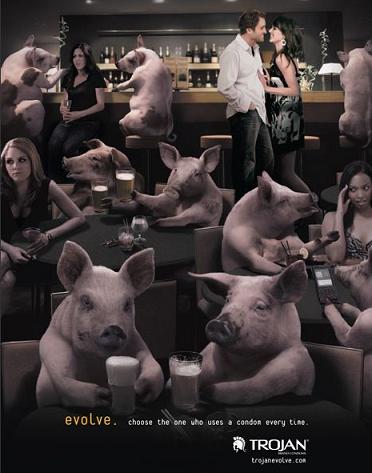
The second advertisement that I would like to analyze has been found frequently within the last year amongst the pages of the popular men’s magazine titled Maxim. The ad is for Trojan condoms and can be viewed to the left of this text (or at http://amysrobot.com/files/trojan_ad.JPG). This ad is somewhat striking because of how is compares men who do not use condoms to protect themselves and their partners from sexually transmitted infections to dirty pigs. The line at the bottom of the ad reads, “evolve. Choose the one who uses a condom every time.” While this is ad is mainly seen in men’s magazines, there is a message to the women who may page through Maxim and run across this ad, because it is asking women if they would want to sleep with a dirty pig who does not use protection, or would they rather have sex with the handsome man who does use Trojan brand condoms every time. This ad also tells the men that if they have a condom with them (or at least use one), they would have a chance at getting with any of the three beautiful women who are surrounded by swine-like men. Like the Singapore Airlines ad that I mentioned above, the genders of men and women area idealized because all they show in the Trojan advertisement are attractive people.
Lastly, I just wanted to quickly comment/rant on/about the new (Starbucks)Red campaign. The ad makes you think about others as not being so different from yourself, and why wouldn't you want to help out by buying a cup of coffee? While the ad is very much pushing the idea of helping others, it falls back on telling their audience that when you help others, you help yourself. I guess this is probably one of the better ways to advertise this in this very egocentric country, because many people will not do things if they don't somehow benefit from it as well. The following ad gets it's audience to think that if he or she goes into Starbucks through the holidays, Starbucks will donate 5 cents from everyone's drink to Africa. I am just a little upset/sickened by this campaign because when I went into Starbucks the other day, I found out that the cup of coffee that I had purchased did not count towards the drinks that 5 cents are being donated from. In actuality, there are only 3 drinks on the menu that actually count, and they are the three most expensive drinks on the menu! I'm just going to leave it at that, or else this could turn into a very lengthy post... but feel free to view the (Starbucks)Red ad below!